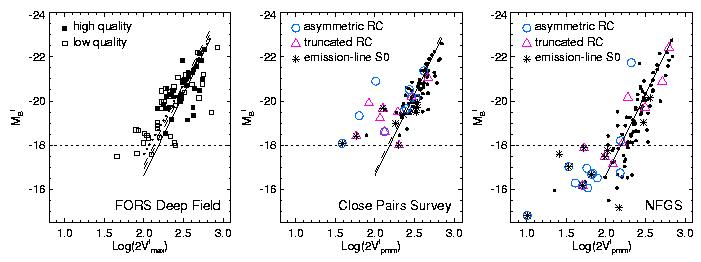
Tully-Fisher relations for the FORS Deep Field (general galaxy population at z~0.1-1, Boehm et al. 2003), the Close Pairs Survey (galaxies in pairs at z=0, Barton et al. 2001), and the Nearby Field Galaxy Survey (general galaxy population at z=0). Triangles and circles indicate severely radially truncated or asymmetric rotation curves in the two low-z samples. Likewise, Boehm et al. identify "low-quality" high-z data points as having radially truncated or asymmetric rotation curves. The solid line is a fit to the NFGS sample, repeated in all three panels. Dashed lines indicate fixed-slope offset-fits, with two lines to show fits with and without the low-quality data in the FORS sample (larger and smaller offsets, respectively). The dotted line shows a free-slope fit to the entire FORS Deep Field sample. By analogy with the Close Pairs Survey, we suggest that apparent slope evolution in the FORS Deep Field probably reflects kinematic anomalies caused by companions or minor mergers. Such interaction-driven anomalies are most common for dwarf galaxies at the present day (NFGS panel), but for a sample favoring interacting galaxies (the Close Pairs Survey) or for a high-z sample reflecting an era when interactions were more common (the FORS Deep Field), we see a higher rate of severe disturbances at intermediate luminosities.
For more info, read the paper.